Weather of the Soul Series: Fog-Trusting the Path You Cannot Yet See
From the Candle’s Glow
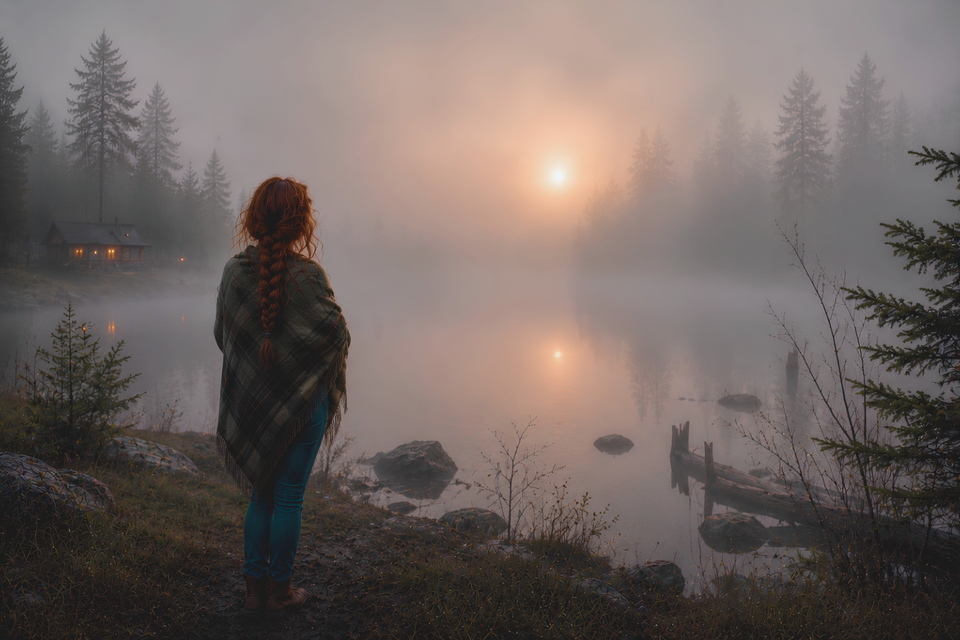
There is something deeply humbling about fog. Unlike storms that arrive with thunder and lightning, fog does not demand attention. It drifts in quietly, softening the edges of the world. Roads disappear into white silence. Trees become shadows. Familiar landscapes lose their certainty.
Fog changes the way we move through the world. It slows us down. It asks us to pay attention. Perhaps most unsettling of all, it forces us to continue forward without seeing the entire path ahead.
There are seasons in life that feel exactly like this. Moments where clarity fades. Where answers feel distant. Where the future that once seemed certain becomes hidden just beyond reach. These seasons can feel uncomfortable, even frightening, because we are taught to trust visibility. We are taught to believe that certainty equals safety. Fog teaches another kind of wisdom entirely. Sometimes the soul grows most deeply when it learns to walk without seeing everything at once.
The Science of Fog: Clouds That Touch the Earth
Fog is essentially a cloud at ground level. It forms when air cools enough for water vapor to condense into tiny droplets suspended near the Earth’s surface. This usually occurs when the temperature and dew point are very close together, creating the perfect conditions for moisture to condense in the air.
There are several types of fog:
- Radiation fog forms when the ground cools overnight, chilling the air above it.
- Advection fog is created when warm, moist air moves over cooler surfaces.
- Valley fog settles into lower elevations where cool air becomes trapped.
- Evaporation fog forms when cold air moves over warmer water.
Fog dramatically reduces visibility because the tiny water droplets scatter light in all directions. Distances become distorted. Familiar landmarks seem farther away—or disappear altogether. Yet even in dense fog, the path itself often remains beneath us. We simply cannot see very far ahead.
The Spiritual Meaning of Fog
Spiritually, fog represents liminal space. It is the in-between. The threshold between what was and what will be. Fog appears during transitional moments in nature, often during shifts in temperature, season, or atmosphere. In the same way, emotional and spiritual fog tends to appear during periods of internal transformation.
These are the seasons when:
- Old versions of ourselves no longer fit.
- The future has not fully revealed itself.
- Certainty dissolves.
- Intuition becomes more important than logic.
Fog teaches us to trust differently. Not through control. Not through perfect clarity but through presence.
Why Uncertainty Feels So Uncomfortable
Human beings are wired to seek predictability. The nervous system feels safer when it knows what comes next. When visibility disappears, anxiety often rises with it. We try to force answers, rush decisions, or search desperately for certainty.
Fog cannot be forced to lift before its time. Nature does not rush clarity, and neither does the soul. Sometimes the most important work we do is learning how to remain grounded while we cannot fully see ahead.
The Quiet Wisdom of Limited Visibility
Fog rarely allows us to see the entire landscape. Instead, it reveals only what is directly in front of us. One step, then another. Spiritually, this mirrors the way life often unfolds. Rarely are we shown the whole path at once. More often than not, we are asked to move forward with a partial understanding, trusting that clarity will come when we are ready for it.
Fog reminds us that:
- Not knowing is part of becoming.
- Uncertainty does not mean failure.
- The path still exists, even when hidden.
There is wisdom in learning to walk slowly enough to listen.
The Nervous System & Fog
Fog changes not only visibility, but the atmosphere itself. Sounds become muffled. Light softens. The environment grows quieter and more inward. This can create a strange emotional effect—both calming and disorienting at the same time.
Many people notice heightened introspection during foggy weather. The softened landscape naturally encourages inward focus, reflection, and contemplation. The nervous system responds to the stillness. The world feels suspended. In that suspension, emotions and thoughts we normally outrun may finally rise to the surface.
Walking Through the Unknown
There are seasons in life where the soul moves through fog. Relationships change. Dreams shift. Old identities dissolve. For a while, we may feel as though we are wandering without direction, but fog is not emptiness. It is a transition.
The hidden path is still there beneath your feet, even when you cannot see where it leads. Every step you take creates the next visible piece of the journey. You do not need the entire map to continue forward. Sometimes you only need enough light for the next step.
A Gentle Fog Practice
The next time fog settles around you, pause for a moment before rushing through it. Allow yourself to breathe more slowly. Instead of resisting uncertainty, practice sitting beside it gently. You do not have to solve everything today. Some answers reveal themselves only after the fog lifts naturally.
Notice:
- How the air feels softer.
- How sound changes.
- How the world grows quieter and more reflective.
The Glow We Carry Forward
Fog reminds us that clarity is not the only form of guidance. There are seasons where the soul is asked to trust without full visibility. To continue walking even when the destination cannot yet be seen. These moments are not punishments. They are invitations. Invitations to slow down. To listen more deeply. To release the illusion that we must always know exactly where we are going.
The fog will not last forever. In time, the air will clear. The landscape will return. The path ahead will become visible again. Until then, there is wisdom in learning how to walk gently through the unknown. Step by step. Breath by breath. Trusting that what is meant for you can still find you, even in the mist.
By Candlelight,
HN Staples
"Not all paths are meant to be seen at once. Some are meant to be trusted into existence."
—HN Staples

Comments ()