The Animal Messenger Series: The Praying Mantis - Messenger of Stillness and Sacred Timing
From the Candle’s Glow
Some messengers announce themselves with a call from the trees or the sudden sweep of wings overhead. Others are so quiet that we might walk past them entirely if we are not paying attention.
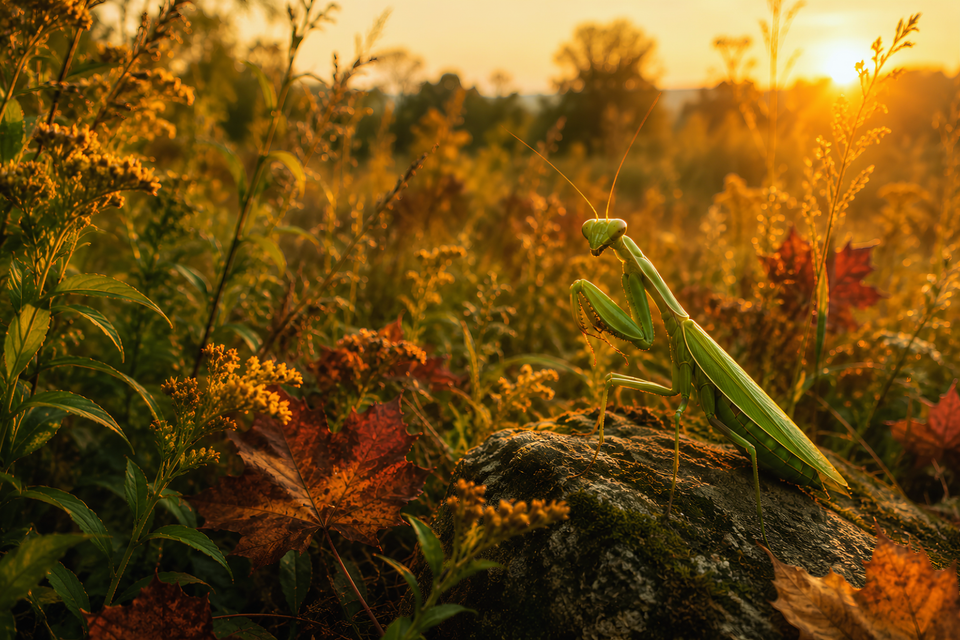
The praying mantis belongs to the quiet ones. There is something almost otherworldly about encountering one. It remains perfectly still among leaves and grasses, its slender body blending into the surrounding green, front legs folded together in the posture that gave it its familiar name. For a moment, it can appear less like an insect and more like a tiny guardian caught in contemplation. The praying mantis does not hurry. It watches, it waits, and that is exactly why its appearance can feel so meaningful.
We live in a world that constantly encourages movement. Make the decision. Take the opportunity. Answer the message. Plan the next chapter. Keep going. Yet nature does not always work this way. Seeds wait beneath the earth. Trees stand bare through winter. Tides retreat before returning. Even the moon disappears into darkness before beginning another cycle.
The praying mantis carries this same wisdom. It reminds us that there are moments when the most powerful thing we can do is become still enough to recognize what is actually happening around us. Not every opportunity requires an immediate answer. Not every path must be followed simply because it appears. Sometimes the soul already knows what to do. We simply haven't become quiet enough to hear it.
The Praying Mantis in Folklore and Symbolism
The unusual appearance and behavior of the praying mantis have fascinated people across cultures for centuries. Even its name carries spiritual imagery. The word mantis comes from ancient Greek and is associated with a prophet or seer. Combined with the insect's folded front legs and extraordinary stillness, it is easy to understand why humans have long associated the mantis with contemplation and mysterious knowing.
Different cultural traditions have interpreted mantises in different ways, but recurring themes include patience, awareness, concentration, stillness, and careful observation. Its symbolism also comes directly from its behavior. A praying mantis can remain remarkably still while observing its surroundings, waiting until precisely the right moment to move. It does not waste energy chasing everything that crosses its path. There is a lesson within that stillness: Discernment is knowing that just because you can act does not mean it is time to act.
The Spiritual Meaning of the Praying Mantis
When a praying mantis crosses your path, you might interpret its appearance as an invitation to reflect on:
- Stillness: creating enough quiet to hear your inner voice.
- Patience: allowing something to unfold before making your move.
- Intuition: trusting what you sense even before you can explain it.
- Discernment: recognizing what deserves your energy and what does not.
- Sacred timing: understanding that the right action at the wrong moment may not produce the same result.
- Observation: looking beneath appearances before deciding what something means.
- Presence: returning your attention to where you actually are, rather than constantly anticipating what comes next.
The mantis does not tell us never to act. Quite the opposite. It teaches us to make our actions meaningful.
The Wisdom of Waiting
Waiting is often misunderstood. We associate it with being stuck. Falling behind. Missing opportunities. Doing nothing while everyone else seems to be moving forward. There is a difference between waiting out of fear and waiting out of wisdom. The praying mantis embodies the latter. Its stillness is active. While its body appears motionless, it is intensely aware of everything happening around it. It is gathering information, conserving energy, and preparing for the moment when movement matters.
There are seasons in our own lives that require this kind of patience. Perhaps you are waiting for clarity about a decision. Perhaps something you have been working toward has not yet come to fruition. Perhaps you can sense that change is approaching, but you cannot yet see its shape. The mantis reminds us that uncertainty does not always need to be solved immediately. Sometimes we are supposed to sit beside the unanswered question for a while.
Knowing When to Move
The praying mantis may be famous for stillness, but it is equally remarkable for how quickly and decisively it acts when the right moment arrives. That distinction is important. Spiritual patience is not endless hesitation. There comes a point when intuition becomes clear. The opportunity arrives. The path opens. Something inside us says, now, and then we must move.
The mantis teaches us the balance between these two energies: Wait without becoming stagnant. Act without becoming impulsive. There is wisdom in both. Knowing which one the moment requires is a matter of discernment.
A Messenger for the Threshold of Autumn
The praying mantis feels especially fitting during late summer and the earliest whispers of autumn. The landscape is still green, yet something has begun to change. The evenings arrive a little earlier. Goldenrod begins appearing along roadsides. Gardens become heavy with everything they have spent the summer growing. The light takes on a warmer, deeper quality. We have entered another threshold.
The mantis can often be found among these late-summer gardens and meadows, quietly inhabiting the space between abundance and release. Its presence asks us to do the same. Before rushing into the next season, look around. What has grown? What has changed? What deserves to be carried forward? And what might need to remain behind? Autumn will eventually ask us to release. The mantis first asks us to observe.
When a Praying Mantis Appears
Sometimes an animal encounter feels different from an ordinary sighting. A praying mantis appears unexpectedly on your porch, rests beside your garden, crosses your path, or seems to remain nearby long enough for you to truly notice it. Rather than immediately searching for a fixed meaning, pause and consider what was happening in your life at that moment.
Ask yourself:
- What have I been rushing?
- Where am I searching for an answer that may need more time?
- What has my intuition already been trying to tell me?
- Is this a moment to move—or a moment to wait?
The most meaningful symbolism is often found in the relationship between the messenger and the moment in which the messenger appeared.
How to Work With Praying Mantis Energy
If you feel drawn to the praying mantis, you might spend time practicing its quiet wisdom:
- Sit outdoors without your phone and simply observe.
- Give yourself time before making an important decision.
- Journal about something you've been trying to force.
- Notice what your intuition says before asking others for their opinions.
- Protect your energy from distractions that do not deserve it.
- Practice becoming comfortable with unanswered questions.
- When clarity finally arrives, trust yourself enough to act.
The mantis teaches us that stillness and action are not opposites. They are partners.
The Glow We Carry Forward
The praying mantis does not chase the world around it. It waits among the leaves, quiet and watchful, trusting that it will recognize the right moment when it arrives. There is something deeply freeing in that. We do not have to respond to every opportunity. We do not have to know every answer today. We do not have to force the next chapter simply because we are uncomfortable standing between pages. Some seasons are meant for movement. Others are meant for listening.
As summer begins its slow surrender toward autumn, may the praying mantis remind you that there is wisdom in the pause between what has been and what comes next. May you become still enough to hear yourself. Patient enough to wait for clarity. When the moment finally arrives—may you trust yourself enough to move.
By Candlelight,
HN Staples
“The praying mantis reminds us that stillness is not hesitation. It is the sacred space where we learn when it is finally time to move.” — HN Staples

Comments ()