Deities of September: The Sacred Balance of Harvest and Descent
From the Candle’s Glow
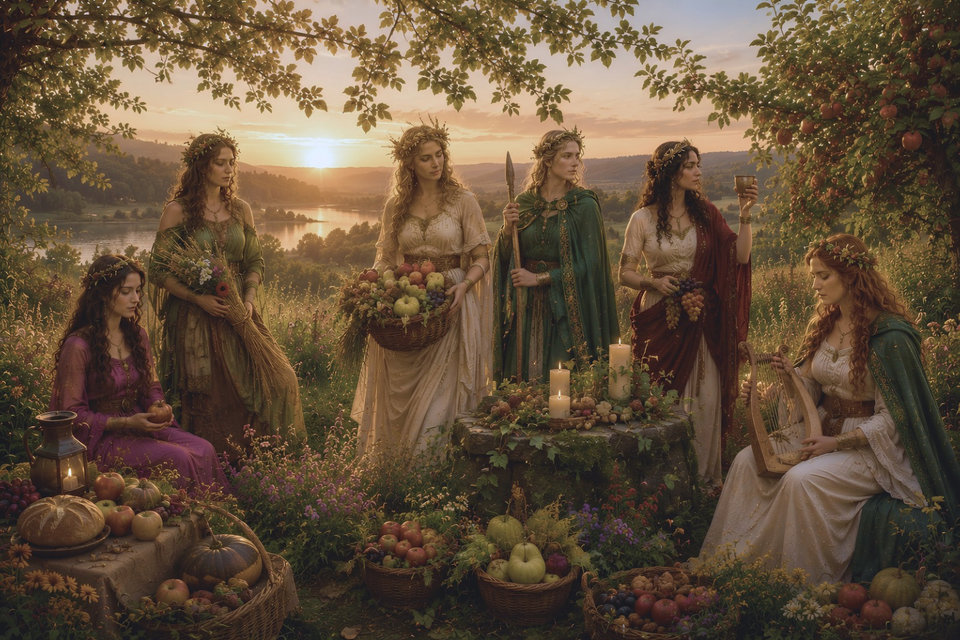
September arrives differently than August. The abundance remains; fields are still golden, orchards bend beneath apples and pears, late-summer flowers linger along roadsides, and warm afternoons can still make us forget, for a moment, that summer is ending, but the light knows. Sunset comes a little earlier. Morning shadows stretch a little farther. A breeze moves through the trees, and somewhere among all that green, the first leaf begins to turn.
September is the month when we begin to understand that abundance and release were never opposites. They belong to the same sacred cycle. This is the season of the gathering basket and the falling leaf. Of gratitude for what has ripened and acceptance of what must return to the earth. By the Autumn Equinox, day and night stand in near-equal measure, creating a threshold between the bright half of the year and the dark. The world is not dying. It is turning inward. That is one of September’s greatest lessons.
Across mythology and ancient tradition, the energies surrounding this season are embodied by deities connected with grain, orchards, wine, motherhood, descent, sovereignty, transformation, and the mysteries of death and rebirth. If August taught us to recognize the harvest, September teaches us to gather it with gratitude—and then loosen our hands. Let us walk into the first golden light of autumn and meet the deities whose stories echo through September.
Deities of September
Persephone: Queen of the Sacred Descent
Few mythological stories embody the turning toward autumn as powerfully as the story of Persephone. Daughter of Demeter and Zeus, Persephone is remembered for her descent into the Underworld and her eventual role as its queen beside Hades.
According to the best-known version of the Greek myth, Persephone is taken into the Underworld. Her mother, Demeter, devastated by her absence, withdraws her fertility from the earth. Crops fail, fields become barren, and the world begins to wither. Eventually, an agreement is reached allowing Persephone to return to her mother for part of the year. Since she has eaten pomegranate seeds in the Underworld, she must return there for another portion of the yearly cycle. Her movement between worlds became one ancient explanation for the changing seasons.
When Persephone returns, the earth awakens. When she descends, the growing season fades. Persephone is more than a maiden carried into darkness. She becomes a queen. That distinction matters. Her story is one of transformation through descent. She crosses a threshold and does not return unchanged.
September carries this same energy. We begin turning away from the outward abundance of summer and toward the inward landscapes of autumn and winter. Persephone reminds us that descent does not always mean failure. Sometimes we must travel inward. Sometimes we must sit with mystery. Sometimes the darkness becomes the place where another version of ourselves is born.
Her symbols include:
- Pomegranates
- Seeds
- Flowers
- Torches
- Grain
- The Underworld
- Seasonal descent and return
September Reflection: What part of myself is asking me to go deeper rather than continue moving outward?
Demeter: The Mother of the Harvest
Beside Persephone stands Demeter. We have encountered her earlier in the Wheel of the Year, but September reveals another side of her story. In spring, Demeter represents the earth awakening. In summer, she represents nourishment and growth. By September, she becomes the keeper of the mature harvest—and the mother beginning to face separation.
Demeter was one of the most important agricultural goddesses of ancient Greece. She governed grain, agriculture, fertility, and the nourishment of the earth. To an agricultural society, her blessings were survival itself. Bread began in her fields. Demeter's mythology also reminds us that love and grief can exist together. She loves Persephone deeply, and because she loves deeply, she grieves deeply.
There is something profoundly autumnal about that truth. September surrounds us with extraordinary beauty precisely because it cannot remain. The leaves become beautiful as they prepare to fall. The harvest becomes precious because it must be gathered. The days become sweeter as they shorten. Demeter teaches us not to avoid attachment simply because loss exists. She teaches us to love the season while we have it.
Her symbols include:
- Wheat
- Barley
- Bread
- Cornucopias
- Torches
- Poppies
- Harvest baskets
September Reflection: What am I grateful to have loved, even knowing I could never keep it forever?
Mabon: The Welsh Figure Behind a Modern Equinox Name
The name Mabon has become deeply associated with modern Pagan celebrations of the Autumn Equinox, but there is an important distinction worth understanding. Mabon ap Modron is a figure from Welsh mythology whose name means approximately “divine son” or “great son.” He is the son of Modron and appears in Welsh tradition, including the tale of Culhwch and Olwen.
The modern use of “Mabon” as the name of the Autumn Equinox festival is much more recent. Even so, Mabon’s mythology carries themes that fit beautifully beside September. He is taken from his mother when he is only three nights old and later imprisoned, hidden away from the world until he is eventually discovered and freed.
His story carries themes of:
- Separation
- Mystery
- Imprisonment
- Liberation
- Mother and child
- Time
- Return
These themes mirror the liminal nature of September. Something is leaving, something is hidden, and something waits beyond what we can presently see. Mabon reminds us that disappearance is not always ending. Sometimes something sacred is simply beyond our sight.
September Reflection: What have I mistaken for an ending simply because I cannot yet see what comes next?
Modron: The Great Mother
If we speak of Mabon, we should also remember his mother. Modron is a mother figure in Welsh tradition whose name is associated with the Great Mother. Her mythology is intertwined with the disappearance of her son, Mabon. This gives her an interesting resonance beside Demeter.
Across very different traditions, we encounter mothers whose children disappear into places beyond ordinary reach. The stories are not identical, and they should not be treated as such. Symbolically, both speak to one of autumn's deepest mysteries: The necessity of releasing what we love into a cycle we cannot control. Modron represents the mother who remembers. The mother who waits. The mother whose connection remains even through separation.
September asks us to consider where we have confused love with possession. Nature never does. The tree does not chase its leaves. The field does not refuse the harvest. The earth understands that love can release.
September Reflection: Can I love something deeply without needing to hold it forever?
Pomona: Keeper of the Autumn Orchard
September is not only grain. It is apples, pears, grapes, figs, nuts beginning to ripen, and orchards heavy with fruit. For this reason, Pomona belongs beautifully within September's sacred landscape. Pomona is the Roman goddess associated with fruit trees, orchards, gardens, and cultivated abundance.
Unlike many agricultural deities associated primarily with grain, Pomona's realm is the orchard. She tends what takes time. An apple tree does not bear fruit overnight; it must take root, grow, survive winter, flower, be pollinated, and finally bear fruit. Pomona therefore carries a quieter lesson about prosperity. Some harvests require years. We live in a world that often celebrates immediate results, but September's orchards tell another story. The sweetest things may be the things we patiently tended long before anyone could see the fruit.
Her symbols include:
- Apples
- Pears
- Fruit trees
- Orchard knives
- Baskets
- Grapevines
- Garden abundance
September Reflection: What have I patiently nurtured that is finally beginning to bear fruit?
Dionysus: The Sacred Joy of the Vine
September also belongs to the grapevine. Across Mediterranean landscapes, late summer and early autumn traditionally bring grape harvests and the beginning of winemaking. Here we meet Dionysus. Greek god of wine, ecstasy, theater, vegetation, and altered states, Dionysus embodies something we sometimes forget when discussing spirituality: Celebration can be sacred. Not every ritual must be solemn. Not every lesson must arrive through hardship. Sometimes gratitude looks like laughter around a table. Music, dancing, fruit passed between friends, and stories told after sunset.
Dionysus reminds us that abundance becomes meaningful when it is experienced. There is little purpose in growing grapes if we never taste them. There is little purpose in creating a life if we are never present enough to live it. Dionysus also carries a deeper mystery. Wine itself is transformation. The grape must be crushed before it becomes something new. Once again, September places abundance and surrender side by side.
His symbols include:
- Grapevines
- Wine
- Ivy
- Theater masks
- Panthers
- Thyrsus staffs
- Figs
September Reflection: Where have I become so focused on becoming that I have forgotten to celebrate being?
The Autumn Equinox: The Sacred Balance
Near September 22 or 23 in the Northern Hemisphere, the Sun crosses the celestial equator, bringing us the Autumn Equinox. Day and night reach near-equal length. For a moment, the year seems balanced between two worlds. Behind us lies summer. Ahead waits autumn's deepening darkness. The equinox is therefore not simply a seasonal event. It is a threshold, and thresholds have always carried spiritual significance. We stand between: Light and darkness. Growth and rest. Holding and releasing. Outer abundance and inner reflection.
The equinox reminds us that balance is not a permanent destination. Nature does not remain balanced. The wheel continues turning immediately. Darkness begins gaining ground. This teaches us something important about our own lives. Balance does not mean keeping everything perfectly equal forever. Balance means recognizing when the season has changed—and changing with it.
September's Sacred Harvest
August celebrated the first harvest, and September deepens it. The fields are gathered, orchards become heavy, pumpkins begin to swell along their vines, grapes ripen, and seeds are collected for another year, and the pantry slowly fills.
Our ancestors understood that harvest was more than abundance. It was preparation. What they gathered now would carry them through winter. Spiritually, September asks the same question: What are you gathering to sustain yourself through the seasons ahead?
- Is it wisdom?
- Is it boundaries?
- Is it memories?
- Is it community?
- Is it faith?
- Or is it the knowledge that you have survived other winters before?
Sacred Symbols of September
September's spiritual landscape is filled with symbols of ripening and transition. Together, they tell September's story: Gather, give thanks, release, and remember.
- Apples: wisdom, abundance, the orchard, and the mysteries hidden within ordinary things.
- Pomegranates: Persephone, descent, transformation, and the connection between worlds.
- Wheat: Demeter, nourishment, harvest, and the reward of patient tending.
- Grapes: Dionysus, celebration, transformation, and sacred pleasure.
- Falling Leaves: surrender and the beauty of release.
- Seeds: what remains after the bloom has faded and what will become life again.
- Baskets: gathering what matters.
- Scales: balance and the Autumn Equinox.
- Candles: the light we begin carrying inward as daylight diminishes.
Working With the Deities of September
You do not need an elaborate altar or complicated ceremony to honor September. Begin with gratitude. Place an apple, pomegranate, grain, bread, or seasonal flower somewhere meaningful. Take a walk through an orchard or along a wooded trail. Watch which leaves are beginning to change. Bake bread. Visit a farmers market. Gather seeds. Sit beside a lake at sunset and notice how much earlier darkness arrives than it did in June.
And ask yourself:
- What has this year given me?
- What am I ready to gather?
- What am I ready to return to the earth?
- What deserves celebration before I move into the next season?
A Simple September Devotional Practice
On or near the Autumn Equinox, create a small space with three things: Something representing what you have grown. Something representing what you are grateful for. Something representing what you are ready to release. Sit quietly before them. Take several slow breaths. Begin with what has grown. Acknowledge the effort it required. Then turn toward gratitude. Name the people, experiences, lessons, and unexpected blessings that have nourished you. Finally, hold the object representing release. You do not have to hate something to let it go. You do not have to regret a season simply because it has ended.
When you are ready, say:
- I gather what nourishes me.
- I give thanks for what has been.
- I release what has completed its season.
Then extinguish a candle, close your journal, or simply step outside beneath the September sky. Let the ritual end quietly. Autumn rarely needs an announcement. It simply arrives.
The Energetic Current of September
It is a month suspended between fullness and letting go. Perhaps that is why September feels so deeply nostalgic. We can see summer behind us while simultaneously sensing autumn ahead. For a brief moment, we belong to both.
September carries the energy of:
- Harvest and abundance
- Gratitude and nourishment
- Balance and the Autumn Equinox
- Release and transition
- Descent and inner reflection
- Celebration and transformation
- Seeds, legacy, and what continues
- Gathering what will sustain us
The Glow We Carry Forward
September teaches us something the trees have always known. There is no shame in changing, no failure in releasing, and no contradiction in grieving something while also being grateful it happened. Persephone walks toward the darkness and discovers sovereignty. Demeter gathers the harvest while preparing for separation. Mabon reminds us that what disappears may someday return. Modron teaches us that love survives distance. Pomona fills the orchard with the fruits of patient tending. Dionysus raises the cup and reminds us to celebrate while the table is still full.
Together, they tell us: Gather what matters. Taste what has ripened. Give thanks for what grew. When the season asks something of you—let it fall. Autumn is not the story of everything dying. It is the story of everything knowing when to return home.
As September's golden light settles across fields, orchards, forests, and quiet water, may you recognize the harvest within your own life. May you gather what will nourish you. May you celebrate what deserves celebration. May you release what has completed its season. May you trust the darkness ahead—not as an ending, but as another sacred part of the wheel.
By Candlelight,
HN Staples
“September teaches us that gratitude and letting go can live in the same hands: one gathers the harvest while the other opens to release.” — HN Staples

Comments ()