Welcoming the Lunar New Year: Honoring the Year of the Fire Horse
From the Candle’s Glow
As the Lunar New Year dawns, we stand at another sacred threshold of time.
While many in the West call it Chinese New Year, this celebration is part of a much broader cultural and spiritual tradition known as Lunar New Year—observed across China, Vietnam (Tết), Korea (Seollal), Singapore, Malaysia, and throughout Asian communities worldwide. It is not merely a date on the calendar. It is a living inheritance of ancestral wisdom, reverence, and renewal.
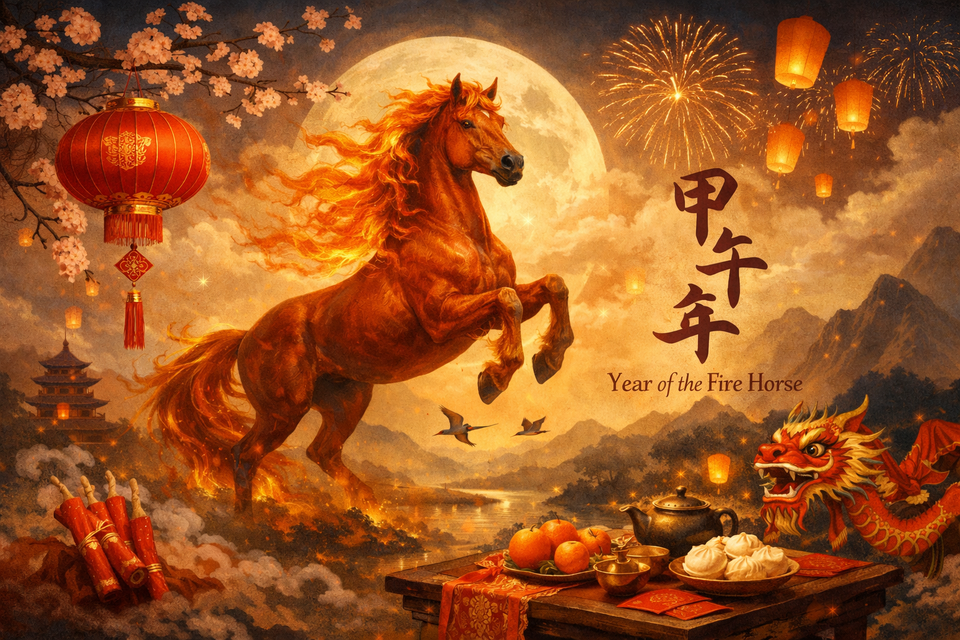
This year carries the bold spirit of the Fire Horse—a symbol of motion, courage, and transformation. Before we speak of energy and archetypes, however, we pause in gratitude for the cultures that have carried these traditions forward for thousands of years.
To honor this New Year is to honor lineage.
The Ancient Roots of Lunar New Year
The Lunar New Year follows a lunisolar calendar, beginning on the first new moon between January 21 and February 20. The celebrations traditionally last fifteen days and conclude with the Lantern Festival—a luminous closing symbolizing hope and reunion.
Its origins trace back more than 3,000 years to early Chinese dynasties, when agrarian communities marked the end of winter and prayed for abundant harvests. Families gathered to offer food to ancestors, light firecrackers to ward off negative forces, and decorate their homes in red—symbolizing protection, vitality, and good fortune.
The well-known legend of Nian, a mythical beast frightened away by loud sounds and the color red, reflects how symbolism and story intertwine with cultural memory. Even today, red envelopes (hongbao), dragon dances, reunion dinners, and temple offerings remain sacred threads woven into this season.
While traditions vary by region, the heart remains the same:
- Honoring elders
- Cleansing old energy
- Inviting prosperity
- Strengthening family bonds
- Beginning again with intention
Understanding the Chinese Zodiac and the 60-Year Cycle
The Chinese zodiac, known as Sheng Xiao, is a 12-year cycle represented by animal archetypes: Rat, Ox, Tiger, Rabbit, Dragon, Snake, Horse, Goat, Monkey, Rooster, Dog, and Pig.
Each year also carries one of the Five Elements: Wood, Fire, Earth, Metal, or Water. The combination of animal and element creates a 60-year cycle of unique energetic patterns.
Unlike Western astrology, which changes monthly, this system aligns identity with birth year and generational rhythm. It is both symbolic and deeply cultural—woven into history, family compatibility, business decisions, and life milestones. Approaching the zodiac with respect means remembering that it is a sacred cultural framework developed over centuries, not merely a form of entertainment.
The Horse Archetype
The Horse symbolizes:
- Freedom
- Independence
- Vitality
- Charisma
- Forward movement
- Fierce determination
Those born in Horse years are often described as spirited, intelligent, and driven. They value autonomy and resist confinement. Their energy is dynamic, sometimes restless, but always moving.
The Horse thrives in open fields—not fenced spaces. Collectively, a Horse year often emphasizes motion over stagnation.
The Fire Horse: Amplified Intensity
When the Horse meets the element of Fire, its energy intensifies.
Fire represents:
- Illumination
- Passion
- Courage
- Visibility
- Transformation
The Fire Horse is bold. Magnetic. Uncontainable.
Historically, Fire Horse years (such as 1966 in the most recent cycle) were regarded in some communities as particularly powerful—sometimes even intimidating. Women born during Fire Horse years were believed to possess especially strong, independent spirits. While modern interpretations move away from superstition, the symbolism reflects the archetype’s intensity.
Collectively, a Fire Horse year may bring:
- Rapid societal movement
- Bold leadership
- Entrepreneurial breakthroughs
- Emotional intensity
- Shifts that cannot be ignored
It is not a year that whispers. It gallops.
Zodiac Harmony and Tension
Traditionally, the Horse harmonizes well with:
- Tiger
- Dog
- Goat
These signs support expansion and shared momentum.
Challenging energy may arise with:
- Rat
Opposition does not mean misfortune—it often means growth through contrast.
Regardless of your zodiac sign, the Fire Horse invites reflection:
Where are you ready to move boldly? What outdated structures must burn away? What dreams require courage rather than caution?
Fire must be guided intentionally. Unchecked, it consumes. Directed, it transforms.
Honoring the Culture with Integrity
Participating in Lunar New Year observances as non-Asian individuals or communities requires humility.
This is not aesthetic décor or zodiac memes—it is a sacred generational celebration rooted in history, resilience, and ancestral reverence.
Ways to honor respectfully:
- Learn about regional traditions rather than generalizing them.
- Support Asian-owned businesses and artists.
- Listen to cultural voices sharing their lived experiences.
- Avoid reducing zodiac symbolism to stereotypes.
- Center gratitude over appropriation.
Cultural respect begins with listening.
The Glow We Carry Forward
As the new moon rises and the Lantern Festival waits on the horizon, we step into the field of the Fire Horse. Not recklessly—but reverently.
May we move with courage without abandoning wisdom. May we embrace passion without losing compassion. May we run toward freedom without forgetting where we came from.
The Fire Horse reminds us that transformation requires movement. That sometimes the soul must gallop toward its own becoming. As we honor the ancient traditions of Lunar New Year, may we do so with gratitude—for the cultures who preserved them, for the ancestors who carried them, and for the future we now shape.
May this year ignite clarity. May it strengthen your spirit. May it carry you forward with intention.
By Candlelight,
HN Staples
"When we honor the roots of a tradition, we honor the people who carried its flame through time." —HN Staples