Weather of the Soul Series: The Language of Rain - Grief, Cleansing, and the Soft Work of Healing
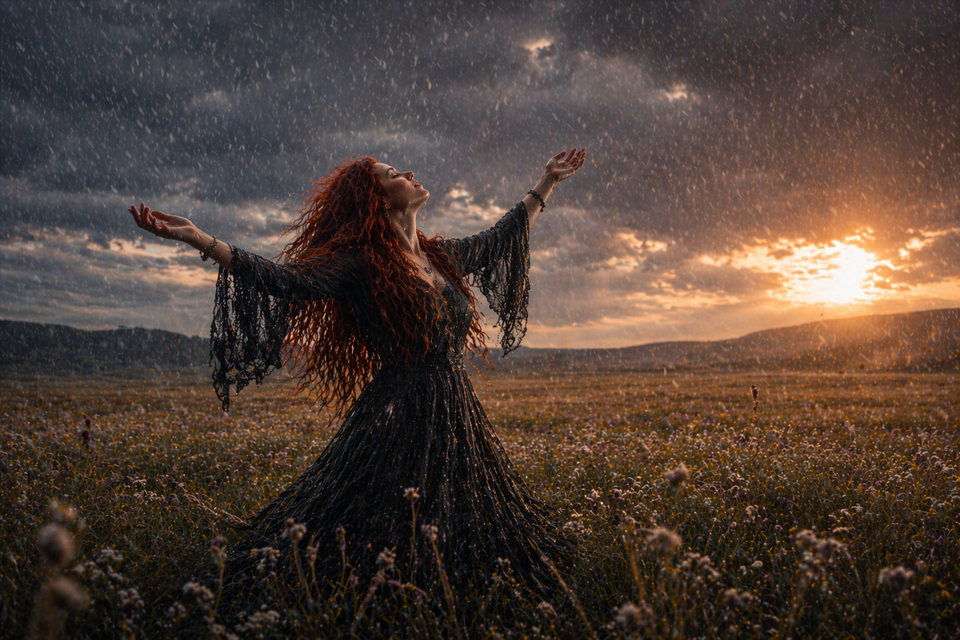
From the Candle’s Glow
There is something about rain that feels like a quiet understanding. It does not arrive with the force of thunder or the urgency of wind. It falls steadily, gently, sometimes barely noticeable at first. A soft tapping against windows. A hush settles over the land. The world becomes quieter, more inward, as if everything is being asked to slow down and feel.
Rain has a way of meeting us where we are. It doesn’t demand anything. It doesn’t rush us forward. It simply falls, over and over again, as if reminding us that some things are meant to be released slowly.
In the rhythm of rainfall, there is permission—permission to soften, to grieve, to let something move through us without needing to name it or fix it. Rain does not force healing. It allows it.
The Science of Rain: The Cycle of Release and Return
Rain begins long before it ever touches the ground. It starts with evaporation—water rising from oceans, lakes, and rivers into the atmosphere as vapor. As this moisture rises, it cools and condenses into tiny droplets, forming clouds.
Over time, these droplets combine, growing heavier until gravity pulls them back to Earth as rain. This process is part of the water cycle, one of the most essential systems sustaining life on this planet.
Rain replenishes soil, nourishes plants, fills rivers, and restores ecosystems. It carries minerals back into the earth and supports every living thing that depends on water to survive. Rain also does something more subtle. It cleans the air.
As it falls, rain captures dust, pollen, and pollutants, pulling them from the atmosphere and bringing them down to the ground. After a rainfall, the air often feels fresher, lighter, and easier to breathe. In this way, rain is both a return and a release. It gathers what has risen, holds it for a time, and then lets it go.
Rain as Emotional Language
Spiritually, rain has long been associated with grief, cleansing, and emotional release. Across cultures and traditions, rain is often seen as the sky’s way of weeping—not out of sorrow alone, but as a necessary act of renewal.
Just as the earth cannot thrive without rain, the human heart cannot fully heal without allowing emotions to move. Grief, like rain, does not always arrive all at once. Sometimes it comes as a steady drizzle—quiet, persistent, lingering in the background of daily life. Other times it falls more heavily, asking us to pause, to sit with what we feel rather than pushing it away.
Rain teaches us that:
- Emotions are meant to flow.
- The release can be gentle.
- Healing does not need to be rushed.
Not all storms need thunder. Some of the most profound transformations happen quietly.
The Soft Work of Healing
There is a kind of healing that does not look dramatic. It doesn’t come with sudden breakthroughs or life-altering realizations. Instead, it unfolds slowly—moment by moment, breath by breath. This is the work rain teaches us. The soft work. It is the act of allowing yourself to feel without needing to explain why. It is sitting with a memory that rises unexpectedly. It is letting tears fall without judging their timing.
Rain reminds us that healing is not always about moving forward. Sometimes it is about allowing something to move through. Just as the earth absorbs rainfall over time, the heart processes emotion gradually. Nothing is wasted. Nothing is unnecessary. Every drop serves a purpose.
The Nervous System and Rain
There is a reason so many people feel calmer when it rains. The steady, rhythmic sound of rainfall can have a soothing effect on the nervous system. This consistent pattern, often referred to as “pink noise,” helps regulate the brain, promoting relaxation and reducing stress.
Rain also signals a slowing of the external world. Activities pause. Light softens. The environment becomes less stimulating, allowing the body to shift out of a state of constant alertness and into a more restful state. In this way, rain supports both emotional and physical healing. It creates space. In that space, the body remembers how to rest.
Grief as a Natural Cycle
Grief is often misunderstood. It is not something to be fixed or rushed through. It is a natural response to loss, change, and transition. Like rain, it comes in waves—sometimes expected, sometimes not.
Rain shows us that grief is not a sign of weakness. It is a sign of depth. It means something mattered. It means something was loved. Just as rain nourishes the earth, grief can deepen our understanding of ourselves and our connection to others. When allowed to move freely, it does not destroy us. It transforms us.
Sitting with the Rain
The next time it rains, consider meeting it differently. Instead of rushing indoors or treating it as background noise. Pause for a moment and listen. Watch how each drop falls without hesitation. Notice the way the world softens—colors deepen, sounds quiet, the air shifts.
You might find yourself breathing more slowly. You might feel something within you begin to settle. Rain does not ask you to be anything other than what you are in that moment. Sometimes, that is exactly what we need.
The Glow We Carry Forward
Rain reminds us that not all healing is loud. Not all transformation arrives with thunder or lightning. Some of it comes quietly—in the spaces where we allow ourselves to feel without resistance, to rest without explanation, to release without urgency.
The sky does not hold its rain forever. It lets it fall, trusting that what returns to the earth will bring life again. We can learn from this. We can allow what we carry to soften, to move, to be released in its own time. When the rain passes, as it always does, the world feels different. Clearer. Lighter. Renewed.
By Candlelight,
HN Staples
"Like rain upon the earth, what we release in softness returns to us as quiet strength."
—HN Staples

Comments ()