Weather of the Soul Series: Floods-When the Heart Holds Too Much
From the Candle’s Glow
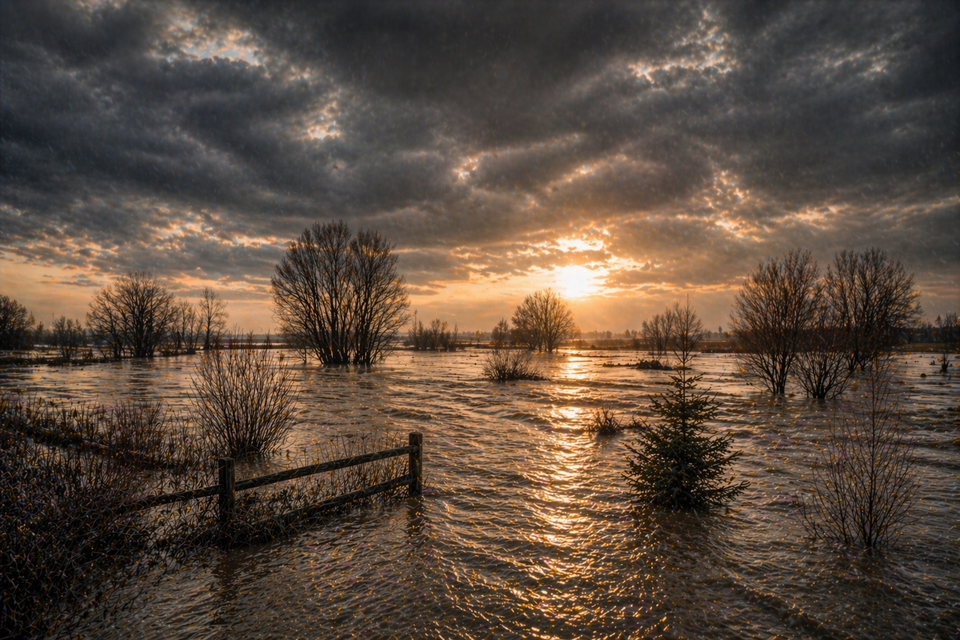
There are moments when the rain does not stop. What begins as something gentle—steady, cleansing, even comforting—slowly becomes something else. The ground can no longer absorb what is falling. Rivers swell beyond their banks. Water spills into places it was never meant to go. Suddenly, what once nourished begins to overwhelm.
Floods do not arrive all at once. They build. Drop by drop, inch by inch, the land reaches its limit. What it once held with ease becomes too much to contain. There is a quiet truth in this that many of us recognize.
There are seasons in life when we carry more than we realize—emotions, responsibilities, memories, expectations. For a while, we manage. We hold it together. We keep moving forward. Until one day, something inside us reaches capacity. Everything begins to spill over.
The Science of Flooding: When the Land Can No Longer Absorb
Flooding occurs when water accumulates faster than it can be absorbed, drained, or carried away.
This can happen for several reasons:
- Prolonged rainfall: Where the soil becomes saturated and is unable to hold additional water
- Flash floods: Caused by intense, rapid downpours, overwhelm drainage systems
- River flooding: When rivers and streams overflow their banks after sustained precipitation
- Snowmelt flooding: When warming temperatures release large volumes of water quickly
Healthy soil acts like a sponge, absorbing rainfall and releasing it slowly over time. But once that soil becomes saturated, any additional water has nowhere to go. It moves outward. Across land. Into homes, fields, and places not designed to hold it.
Floodwaters are powerful. They reshape landscapes, erode foundations, and alter the course of rivers. Yet they are also part of natural cycles. Floodplains, for example, rely on periodic flooding to deposit nutrients that enrich the soil. Even in their intensity, floods carry a dual nature: destruction and renewal.
Emotional Flooding: When the Heart Reaches Capacity
Spiritually, floods represent emotional overwhelm. They are the moments when feelings that have been quietly building over time suddenly surface all at once.
Grief layered upon grief. Stress layered upon stress. Unspoken truths, unprocessed experiences, and quiet endurance gather beneath the surface. Until something shifts and the heart can no longer contain it.
Emotional flooding may look like:
- Crying without a clear reason.
- Feeling everything all at once.
- Shutting down because it’s too much to process.
- A sense of being overtaken by your own inner world.
These moments can feel frightening, but they are not failures. They are signals. They are the body and spirit saying: this needs space, this needs care, this needs release.
The Difference Between Release and Overwhelm
Rain teaches us to release. Floods teach us what happens when we hold too much for too long. Where rain is gentle and rhythmic, flooding is often sudden and consuming. It reminds us that there is a limit to what we can carry without support. This is not a weakness. It is designed.
Just as the land cannot endlessly absorb water, we are not meant to endlessly absorb emotional weight without tending to it.
Floods invite us to ask:
- What have I been holding onto?
- Where have I ignored my own limits?
- What needs to be released before it overwhelms me?
The Power Within the Overflow
Floods are not only about destruction. They are also about movement. Water that once remained contained begins to flow freely, reaching places it could not before. It changes the shape of the land. It carves new paths.
In emotional terms, flooding can bring awareness to parts of ourselves we have long avoided. It can force honesty where there has been silence. While overwhelming, it can also be clarifying. It shows us what matters. It shows us what hurts. It shows us what needs care.
The Nervous System in Overwhelm
When we experience emotional flooding, the nervous system often shifts into a state of overload.
This can look like:
- Heightened anxiety
- Emotional shutdown
- Difficulty thinking clearly.
- A strong urge to escape or withdraw.
The body is trying to protect itself from too much input at once. In these moments, the goal is not to “fix” everything immediately. The goal is to create safety. To slow down. To give the system time to regulate. Just as floodwaters eventually recede, the nervous system can return to balance when given space and support.
Finding Ground Again
After a flood, the land looks different. It may feel unfamiliar, even damaged. But over time, something begins to shift. Water recedes. The ground dries. Life returns.
In our own lives, emotional overwhelm may leave us feeling disoriented at first. But it also creates an opportunity to rebuild in a way that more fully honors our limits. To create stronger boundaries. To release what we were never meant to carry alone. To tend to ourselves with greater compassion.
The Glow We Carry Forward
Floods remind us that there is a limit to what we can hold. That reaching that limit is not failure. It is a turning point. A moment where something within us asks to be acknowledged, supported, and released. The waters may rise. They may feel overwhelming, but they do not stay forever.
In time, they recede, and what remains is a deeper understanding of ourselves—our capacity, our resilience, and our need for care. Even after the heaviest rains, the land finds its way back to balance. And so do we.
By Candlelight,
HN Staples
"When the heart overflows, it is not breaking—it is asking to be held." —HN Staples

Comments ()