The Winter Solstice & The Cailleach: Keeping Vigil at the Longest Night
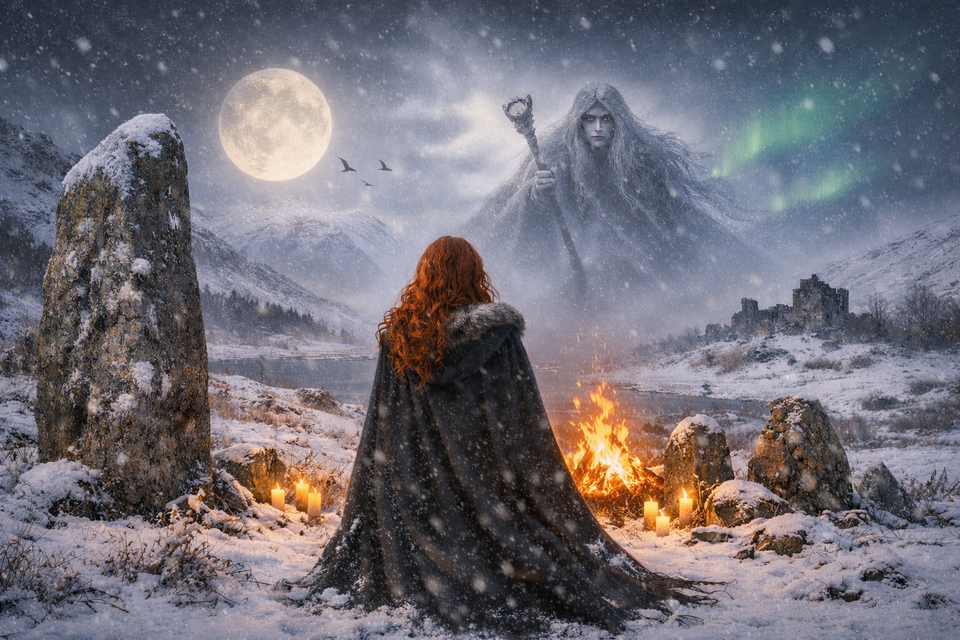
The Winter Solstice arrives each year around December 21, marking the year's longest night and shortest day. It does not come with light. It arrives with darkness—deep, settled, and complete.
This is the moment when the world stands as still as it ever will. Nothing blooms here. Nothing resolves. And yet, something quietly shifts. On this night, the sun turns—not forward, but inward—and begins its slow return, unseen.
The days that follow lengthen only by seconds at first—the cold remains. Winter still holds the land. But the direction has changed—and that is everything. It is in this darkness that I feel the presence of The Cailleach most clearly. Not as a myth. Not as a symbol. But as winter itself—ancient, watchful, and unyielding.
Through my Scottish heritage and my spiritual practice, I have come to understand that this night was never meant to be rushed or brightened prematurely. My ancestors did not meet the Solstice with celebration, but with awareness. They understood winter as a season to be endured with patience, respect, and restraint. And at the heart of that understanding stood The Cailleach.
Keeper of Winter, Holder of the Land
The Cailleach is among the oldest figures in Celtic tradition—keeper of winter, shaper of mountains, and embodiment of the land’s endurance. Across Scotland, Ireland, and the Isle of Man, she is known as the one who governs the dark half of the year, holding the earth in stillness while it rests beneath frost.
She is said to form hills and stone ridges by dropping rocks from her apron, her body becoming the bones of the land itself. She is age without apology—strength without softness. Time made visible. The Winter Solstice does not belong to her by name—but it belongs to her by nature.
This is the moment when winter stands fully in its power. The light has turned, but it has not returned in any way that can be seen or felt. The land remains cold. The nights remain long. And she still holds her place.
The Solstice as Vigil, Not Victory
The Winter Solstice is often spoken of as the return of light—and that is true, but incomplete. This night is not a celebration of brightness. It is a vigil.
The Solstice marks a threshold, not a resolution. The light does not surge forward. It returns slowly, almost imperceptibly, asking to be trusted rather than witnessed.
Under the Cailleach’s watch, the Solstice teaches us:
- That rest is not weakness.
- That stillness is not stagnation.
- That endurance is sacred.
She does not release winter on this night. She allows the cycle to turn while winter remains firmly in place. Growth is not demanded. Patience is.
In my own practice, this night is not about calling the light back—it is about honoring the darkness that carried me here.
Ancestral Memory in the Longest Night
My ancestors understood The Cailleach not as a figure of worship, but as a presence to be respected. Through harsh winters and long nights, they learned to listen—to storms, to frost, to silence. Survival required it.
When I honor The Cailleach at the Winter Solstice, it feels less like devotion and more like remembrance. The pull toward winter landscapes, stone, and northern quiet feels embedded in my bones—ancestral knowledge surfacing through instinct rather than instruction.
Through her, I feel connected to an older rhythm of living—one where people understood when to act and when to endure. Where the land was not conquered, but listened to. This is wisdom carried not in books, but in the body.
What the Longest Night Asks of Us
In a world that glorifies constant productivity and perpetual brightness, The Cailleach offers a necessary counterbalance.
At the Winter Solstice, she asks us to:
- Stop forcing forward movement.
- Release the need for immediate clarity.
- Honor rest as an act of wisdom.
- Trust the unseen work happening beneath the surface.
This is not a night for resolutions. It is a night for recognition. Recognition of what we have survived. Recognition of what still needs tending. Recognition of the strength forged quietly, without witness.
Closing Reflections
The Winter Solstice does not promise warmth—but it does promise truth. Under the Cailleach’s watchful presence, we learn that darkness is not an enemy, but a teacher. One that asks us to remain steady, rooted, and patient.
Through her, I have come to understand that my spiritual path is shaped as much by ancestry and land as it is by intention. She reminds me that I come from people who knew how to endure winter—who trusted the turning of the year even when the night felt endless.
As the Solstice passes and the light begins its slow, honest return, I do not rush ahead. I remain here—like stone beneath snow, like land resting under frost, like those who came before me.
Winter is not finished yet. And the work of becoming doesn't need to be hurried.
By Candlelight,
HN Staples
“The longest night is not an ending—it is the land holding its breath before remembering how to turn toward the light.” —HN Staples