Listening to the Sun: Solar Storms and Their Influence on Body, Heart, and Soul
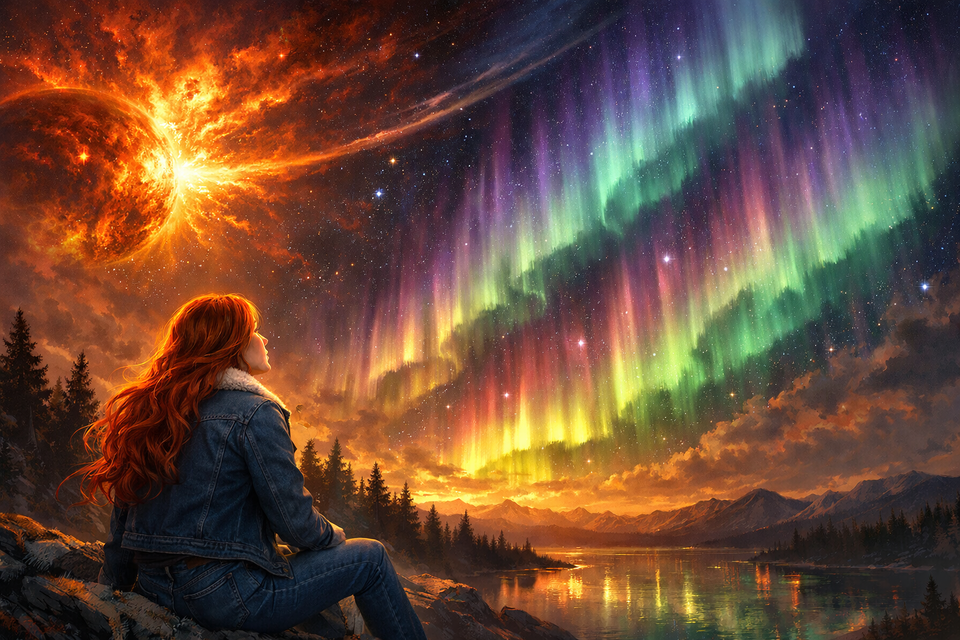
There are moments when the sky feels closer than usual. Not because clouds hang low or stars shine brighter—but because something ancient is moving beyond our sight, beyond our atmosphere, beyond the quiet rhythm of our ordinary days. The sun, our life-giver, our constant companion in the sky, sends waves of energy across the vast dark of space, and sometimes those waves reach us here, brushing against the invisible fields that protect and surround our world.
This week, that stirring feels especially present. Scientists have reported that the solar activity unfolding right now is the strongest we have experienced in nearly twenty years—a reminder not just of the sun’s power, but of our place within a living, breathing cosmos that is always in motion, whether we notice it or not.
We call these moments solar storms. To science, they are eruptions of plasma and magnetic force. To the soul, they often feel like subtle shifts in the air—restlessness without a clear reason, deep fatigue that sleep does not quite cure, emotions that rise to the surface as if carried on a tide we didn’t summon.
For as long as humans have watched the sky, we have known that the sun is not just a light in the heavens, but a presence—a rhythm-setter, a timekeeper, a silent guide for seasons, harvests, migrations, and inner cycles. When the sun stirs, something in us often stirs too.
This is not about fear or superstition. It is about awareness. About remembering that we are not separate from the world above us or the earth beneath us. We live inside a living system—cosmic, terrestrial, and deeply personal all at once.
So when the sun speaks in bursts of fire and light—as it is doing now, more strongly than it has in decades—it is worth listening. Not just with instruments and data, but with the body, the heart, and the quiet inner places where meaning often waits.
What Is a Solar Storm?
At its core, a solar storm begins with intense activity on the sun's surface. The sun is not a calm, burning sphere—it is a constantly moving ocean of charged particles and magnetic fields. When those magnetic fields twist and snap, they can release enormous bursts of energy into space.
These events often take the form of:
Solar Flares
Sudden flashes of light and radiation that travel at the speed of light. When aimed toward Earth, they can affect radio signals, GPS systems, and satellite communications.
Coronal Mass Ejections (CMEs)
Massive clouds of charged particles are launched from the sun’s outer atmosphere. These take one to three days to reach Earth and can interact with our planet’s magnetic field.
When a CME reaches Earth, it can disturb the magnetosphere—the invisible magnetic shield that protects our planet. This disturbance is what creates auroras, those dancing ribbons of green and violet light in polar skies. It can also affect power grids, navigation systems, and technology.
Earth itself absorbs most of the physical impact. We are not directly exposed to solar radiation at the surface. Still, many people report feeling different during periods of heightened solar activity—and this is where science, perception, and personal experience begin to quietly meet.
The Birth of the Aurora: When the Sky Becomes Light
As charged particles from a solar storm stream toward Earth, most are guided by our planet’s magnetic field toward the poles. There, they meet the gases in our upper atmosphere—primarily oxygen and nitrogen—and when these particles collide, energy is released as light.
This is how auroras are born. Green is the most common color, created by oxygen at lower altitudes. Red can appear higher in the sky, also from oxygen, while purples and blues come from interactions with nitrogen. The result is a slow, shimmering dance across the night sky—curtains, arcs, and ripples of living light. To science, this is a beautiful and measurable process of energy transfer. To the human spirit, it often feels like the sky is breathing.
For centuries, cultures across the world have seen auroras as messages, ancestors, spirits, or divine signs—not because they lacked understanding, but because wonder has always been part of how humans relate to the cosmos. Even now, when we can explain the physics, the experience itself still stirs something ancient inside us.
The aurora becomes a visible reminder of something we usually cannot see: that the Earth is constantly in relationship with the sun, wrapped in invisible fields of protection, exchange, and response.
Physical Sensations: Listening to the Body
While research is ongoing, some studies suggest that changes in Earth’s magnetic field may subtly influence the human nervous system, which operates through electrical signals. This doesn’t mean solar storms “cause” symptoms—but they may act as a kind of environmental stressor, especially for sensitive systems.
People often describe physical experiences such as:
- Unusual fatigue or heaviness in the body
- Headaches or pressure behind the eyes
- Restless sleep or vivid dreams
- Muscle tension or joint discomfort
- A sense of being “wired and tired” at the same time
The heart and brain both rely on electrical rhythms. Some researchers have explored whether geomagnetic activity may correlate with changes in heart rate variability and stress responses. While this field is still developing, it points to an interesting possibility: that our bodies may be more environmentally responsive than we consciously realize.
Whether scientifically measurable or deeply subjective, these moments invite a simple and compassionate response: to slow down, hydrate, rest when possible, and listen rather than push through.
Emotional Shifts: The Inner Weather
Just as the sky can turn stormy, so can the emotional landscape.
During periods of intense solar activity, many people report heightened emotions—not necessarily negative, but amplified. Joy can feel brighter. Sadness can feel heavier. Old memories may resurface without warning. Thoughts that were once quiet may grow louder.
This can be understood in a grounded way: when the nervous system feels stressed, even subtly, emotional regulation can become more delicate. Small things may feel bigger. Silence may feel deeper. Connection may feel more needed.
Rather than seeing this as something to “fix,” it can be viewed as a gentle opening—an invitation to tend to what is asking for attention.
You might ask yourself:
- What am I feeling more clearly right now?
- What needs softness instead of strength?
- What wants to be expressed instead of held inside?
Emotional tides often carry meaning. Solar storms, in their own strange way, can feel like cosmic mirrors—reflecting back what has been quietly waiting beneath the surface.
Spiritual Reflections: When the Sky Feels Like a Messenger
Across cultures and centuries, the sun has always been more than a star.
It has been seen as a symbol of consciousness, spirit, divine order, and life force. From ancient solstice rituals to modern meditative practices, humans have long aligned their inner worlds with the movement of the heavens.
Spiritually, solar storms are often experienced as moments of “thinness”—times when people feel more open, more sensitive, more aware of something beyond the physical.
Some describe:
- A desire for solitude or reflection
- A feeling of being energetically “cleansed” or unsettled
- A renewed urge to release old patterns
- A deeper connection to nature, sky, and earth
Whether viewed symbolically or intuitively, these moments can become powerful thresholds—not because the sun is doing something to us, but because we are more willing to listen.
The sun, after all, reminds us of cycles. Expansion and contraction. Light and quiet. Energy and rest. It burns, and then it softens. It rises, and then it sets. So do we.
Grounding Practices for Solar Storm Days
When the world above feels active, the world below becomes even more important.
Here are gentle, grounding ways to support yourself:
Return to the Earth
Walk barefoot on grass, soil, or stone. Touch a tree. Sit with your back against something solid and living.
Simplify Your Day
Fewer tasks. Softer expectations. More space between moments.
Hydrate and Nourish
Water helps regulate the nervous system. Warm, grounding foods can help the body feel safe and settled.
Breathe With Intention
Slow, deep breathing tells the body it is not in danger, even when emotions or sensations feel heightened.
Write or Reflect
Let thoughts move from inside to paper. Often, what surfaces during these times carries quiet wisdom.
Closing Reflections
It is easy to forget that we are part of something vast. We live inside schedules, screens, and walls—measuring time by clocks instead of stars, by calendars instead of seasons. But the sun still rises. The magnetic fields still hum. The Earth still turns, carrying us through a living, breathing cosmos.
Solar storms are not warnings. They are reminders. Reminders that we are not separate from the sky. That our bodies are not separate from the Earth. That our emotions are not separate from the deeper currents of being alive.
When the sun sends its waves of fire and light across the dark, and they brush against our world, we can choose to meet them with fear—or with curiosity. We can pause. We can breathe. We can listen.
Sometimes, the greatest messages are not written in words, but in warmth on the skin, restlessness in the heart, and a quiet knowing that we belong to something far larger—and far more beautiful—than we can ever fully name.
By Candlelight,
HN Staples
“You are not beneath the sky—you are part of its story, written in breath, light, and becoming.” —HN Staples