Folklore & Ghostly Tales: The Whispers From Appalachia & Shorelines Of The Deep South
Between The Mountain Whispers & Coastal Tides
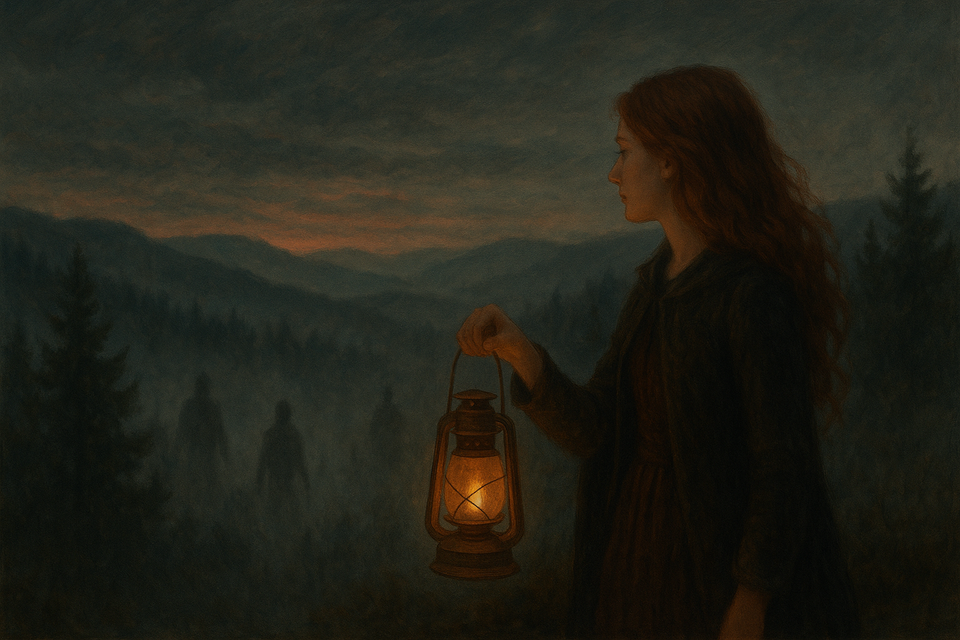
When the autumn fog drapes itself over the ridges of the Appalachians, time seems to fold in on itself. The air still grows. The woods begin to hum. It’s in these moments that the veil feels thin — where every rustle of leaves, every echo in the holler, could be the whisper of something ancient that never truly left.
Stretching from the northern slopes all the way down to Alabama’s rolling foothills, the Appalachian Mountains are a cradle of folklore. Here, every shadowed hollow holds a memory, and every bend in the river has a ghost story waiting to be told.
The ghosts of the Appalachians do not stop at the ridgelines. They travel—down winding roads, through pine forests, across riverbanks, and all the way to the salt-touched shores of Alabama.
These are the spirits of place: born of story, grief, and memory. They are the echoes that remind us that time is never linear, and the land never forgets.
Appalachian Folklore
There’s something about the Appalachian woods after dusk — a hush that feels alive, as though the mountains themselves are breathing. The deeper you go, the more the silence hums, until you realize it isn’t silence at all. It's a memory.
The Appalachians hold stories older than the roads that cross them — tales of ghostly footsteps, haunted hollers, and the wild, ungoverned spirit of the forest itself. These are not just ghost stories; they are the whispers of the land, the living folklore of Appalachia.
The Wild Man
Before the world called him Bigfoot, Appalachia had its own name: The Wild Man of the Woods. He was said to roam the ridges and beyond — a towering, hairy creature with eyes that glowed red in the firelight and a scream that froze the blood.
Early settlers spoke of him taking livestock, vanishing into the pines, or standing motionless at the edge of torchlight. The Cherokee told older stories — of forest guardians and shape-shifters who protected the mountain realms from intruders.
Today, locals whisper of strange howls echoing through the hills, of massive tracks found in soft earth, of a shadow watching from between the trees. Whether spirit, beast, or something older than either, the Wild Man remains the mountain’s most elusive secret — the embodiment of the wilderness that refuses to be tamed.
The Mothman Of Point Pleasant
In the quiet town of Point Pleasant, West Virginia, a legend was born in the late 1960s — a winged creature with glowing red eyes that haunted the night skies. The locals called it Mothman, a dark omen whose sightings preceded the tragic collapse of the Silver Bridge in 1967.
Some say he was a messenger. Others call him a monster. But in the misty lore of Appalachia, even monsters have meaning — they remind us that unseen forces move alongside us, warning, watching, waiting.
The Wampus Cat
Farther south, through the Cherokee hills and thick forests, comes the tale of the Wampus Cat — half woman, half cougar. The story tells of a Cherokee woman who defied taboo by watching a sacred men’s ritual. As punishment, she was cursed to roam the mountains forever, her spirit trapped between worlds.
Her cries echo through moonlit hollows, reminding wanderers of the danger of curiosity — and of the wild, untamed feminine that cannot be silenced.
The Raven Mocker
In Cherokee tradition, the Raven Mocker is a spirit that visits the dying, stealing their final breath and adding their remaining years to its own. It flies on invisible wings, its wail like that of a raven echoing across the hills.
The elders say that healers can sense when the Raven Mocker approaches, calling upon ancient prayers and cedar smoke to protect the soul. These stories, dark as they seem, are not just tales of fear — they are stories of guardianship, of keeping watch at life’s thresholds.
Ghostly Tales From Tennessee To The Shores Of Alabama
From the fog-wrapped ridges of Tennessee to the salt-kissed shores of Alabama, the South hums with stories that refuse to die. The same wind that sighs through the Appalachian hollers drifts downriver to whisper along the Gulf, carrying memories of laughter, loss, and things unseen.
Here, ghost stories are not meant to frighten — they are meant to remember. Every haunted fort, every lonely cabin, every echo in the pines reminds us that the land itself keeps its secrets well. If you listen closely, you may hear the soft steps of history walking right beside you.
The Bell Witch
There is no ghost story that chills quite like the Bell Witch haunting of Adams, Tennessee.
Between 1817 and 1821, the Bell family reported relentless torment from an unseen spirit: voices that mocked, furniture that moved, and blows that left bruises. Neighbors claimed to hear it speak in multiple tones—some swore it sang hymns; others said it cursed.
Legend holds that the Bell Witch poisoned John Bell himself and then vanished into the woods, promising to return in seven years. Whether spirit, curse, or mirror of collective fear, the Bell Witch endures as the South’s most famous phantom—an echo of guilt and warning that the hills still carry.
The Spirit Of Roan Mountain
Among Tennessee’s highest peaks, Roan Mountain holds its own quiet mystery. On clear nights, a strange blue glow ripples across the summit, and hikers have reported seeing a man in weathered clothes standing alone on the ridge. When approached, he disappears.
Old tales claim he was a soldier who died in a winter storm, his body never found. Others believe he’s a guardian of the mountain — a spirit watching over those who climb too far, too fast, into the mists.
Whatever the truth, the air on Roan feels heavy with presence. The wind there doesn’t just move through the trees — it speaks.
The Fiddler’s Song Beneath The Stone
High in Johnson County, Tennessee, stands a massive rock formation known as Fiddler’s Rock. The story tells of a young musician who struck a bargain for fame — his fingers blessed with unnatural skill, his songs enchanting every ear that heard them.
But one night, under the ghostly light of the full moon, he vanished. Only his fiddle remained, lying against the stone.
Now, when the fog thickens and the mountain air stills, a faint melody drifts through the holler — mournful and wild, like the echo of a soul still playing for its freedom. Travelers swear that if you stop and listen, the tune follows you home.
From The Appalachian Hills To The Heart Of Alabama
Now that I call Alabama home, I’ve come to learn that the Appalachian spirits didn’t stop at the Tennessee line — they followed the mountains south, settling into riverbanks, graveyards, and the small towns that dot the landscape.
Here in the Deep South, the ghosts have their own language: one of oak roots, river fog, and Southern memory.
Sweetwater Mansion
In Florence, Alabama, Sweetwater Mansion stands as both architectural beauty and spectral haven. Built in 1835, its grand rooms once held gatherings, laughter, and the rhythm of plantation life—but time has turned its echoes hollow.
Visitors speak of cold spots and faint murmurs drifting from locked rooms. One caretaker claimed to see the body of a Confederate soldier laid out in an upstairs parlor—only for it to vanish the next moment.
Some say it was the spirit of the owner’s son, killed in battle and mourned for decades. Others say the walls simply hold too much grief to rest quietly.
Even by day, Sweetwater feels caught between centuries—a house still waiting for those who never came home.
The Fort Of Colonial Mobile
In downtown Mobile, where cobblestone streets meet coastal wind, the Fort of Colonial Mobile (also known as Fort Conde) guards its secrets behind brick and iron.
Built upon layers of colonial history—French, British, Spanish, and American—the fort carries centuries of unrest.
Visitors report the sound of marching boots echoing through the tunnels, shadows moving along the walls, and sudden chills in the inner courtyard. Tour guides often say the energy here is “alive,” as if the soldiers who once defended these grounds have simply changed shifts, not centuries.
Stand in its courtyard at dusk, and you might feel the weight of eyes unseen—a city’s memory watching through the veil of time.
Fort Gaines - Guardian Of The Gulf
Across the bay, on windswept Dauphin Island, rises Fort Gaines, its cannons still facing the water, its ramparts heavy with salt and sorrow.
Built in 1821, the fort witnessed the Battle of Mobile Bay in 1864—“Damn the torpedoes, full speed ahead!”—and the spirits of those who perished seem bound to the stones themselves.
Today, visitors speak of phantom footsteps on the battlements and a soldier’s silhouette drifting along the seawall before vanishing into the mist. Inside the tunnels, the air grows cold, and the sea wind carries whispers too soft to belong to the living. It is said that when the tide rises high and the moon burns orange, you can still hear the clang of metal and a distant voice shouting orders lost to history.
Side Note: Paranormal research groups have listed Fort Gaines among Alabama’s most haunted forts, and ghost tour operators include it in their investigation events. While a fully published investigation report remains elusive, Fort Gaines is frequently featured in local paranormal listings and visitor accounts of unexplained phenomena.
The Dancing Ghost Of Grancer Harrison
In Coffee County, Alabama, the legend of Grancer Harrison still lingers. He was a man who loved nothing more than a good dance, and even after his death, he was said to rise from his grave on moonlit nights to waltz upon the earth once more.
Locals claim that if you listen closely, you can hear fiddle music drifting from his resting place — a reminder that joy, once truly lived, cannot be buried.
The Phantom Steamboat Of The Tombigbee
Near the town in Pennington, Alabama, in March of 1858, the Eliza Battle, a grand steamboat carrying passengers and cotton, caught fire on the Tombigbee River. Dozens perished as flames lit up the water.
Fishermen still tell of seeing a ghostly ship gliding silently along the river on bitter winter nights — its decks aflame, its passengers frozen in time. The Alabama waters remember.
Haunted Roads & Hollows
If you drive down Highway 5 after midnight, between Nauvoo and Natural Bridge, and you might see her — a young woman in white, walking the roadside, forever trying to find her way home.
Alabama’s haunted highways remind us that some journeys never truly end — they just echo through time, carried on the hum of distant tires and the sighing wind through the pines.
What The Folklore & Ghostly Tales Remind Us
These tales remind us that the earth itself remembers — that the fog curling through the hollers, the water on the ocean shores and the hum beneath the soil are voices of what came before.
Ghosts and wild men, music and mist — they all belong to the same ancient heartbeat that pulses through the Appalachian range and the ocean shores.
The next time you find yourself alone on a mountain path or an ocean shore at dusk, listen closely. The trees and the salty air might be telling you something. If you hear a fiddle, or a distant laugh carried on the wind. Perhaps you’ve wandered a little too close to the veil.
Closing Reflections
What ties all of these stories together is the way the land holds memory. Mountains and rivers don’t forget. They listen. They keep watch. Every legend is a love letter to the place it was born — a way for us to make sense of the strange, to find meaning in the mist. The ghosts aren’t here to scare us; they’re here to remind us that history breathes through us, that our ancestors linger near, that energy never truly fades.
From the shadowed hollers of the mountains to the whispering edges of the sea, every tale of folklore and haunting carries the same quiet pulse—the persistence of memory. These are echoes of unfinished stories, reminders that every place holds both beauty and burden within its bones.
Each ghost story is more than a chilling encounter; it’s a thread, binding us to the souls who once walked these paths, breathed this air, and shaped the land we now call home. In the misty folds of Appalachia, legends are not just told—they are felt. The ancient ridges of Appalachia seem to hum with these memories still, carrying the truth of their mysteries through the folds of time and mist.
When we listen—truly listen—to the silence between footsteps or the whisper beneath the waves, we are participating in an ancient ritual: remembering what the earth does remember. It's here to remind us that nothing sacred ever really leaves.
As you sit and sip some tea this Samhain, think of the stories from the mountains and the sea. The music drifting through fog, the haunted forts and roads that breathe through time. Perhaps take a moment to listen — to the hum of the land beneath your feet, to the silence between wind gusts. You may just catch a whisper from the mountains or shorelines, a story not yet finished.
By Candlelight,
HN Staples
“The past is not gone; it lingers in the air, folded between the hills and tides, waiting for those who listen.” -H.N. Staples