Brigid of the Sacred Flame: Honoring the Goddess Who Writes Through Me
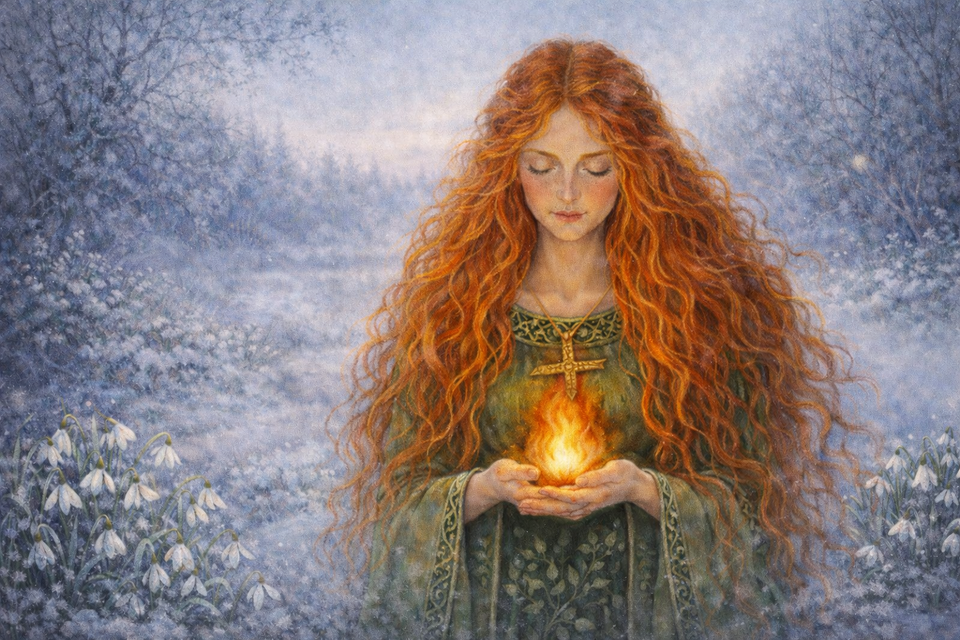
From the Candle's Glow
There are certain presences in our lives that do not arrive loudly. They come softly, like the first warmth through a winter window, like a candle lit in a quiet room, like a word that lands on the page before we realize we have written it. For me, Brigid has always felt like that—not a distant goddess to be reached for, but a gentle flame that walks beside me.
Imbolc has become more than a seasonal marker in my life. It has become a homecoming. A moment each year where I pause my writing, my rituals, my everyday movement through the world, and turn inward to thank the presence that first taught me how sacred my own voice could be.
Before I understood her history, her myths, her many names, I felt her in my poetry. In the way sentences would arrive when my hands hovered over the page. In the way warmth would settle in my chest when I wrote something that felt true, healing, and alive. Brigid was the first deity I ever worked with, and in many ways, she is still the one who reminds me why I write at all.
This post is not just an offering of knowledge. It is an offering of gratitude. Of memory. Of devotion. Of the flame that still burns quietly in the center of my creative life.
Who Is Brigid?
Brigid is one of the most beloved and enduring figures in Celtic tradition, honored as both a goddess and a saint—a rare bridge between ancient spirituality and Christian reverence.
In her earliest form, Brigid is an Irish goddess associated with:
- Poetry and Inspiration
- Healing and Wellness
- Fire and the Hearth
- Craft, Smithing, and Sacred Work
- Protection and Hospitality
She is often described as a triple goddess, embodying three sacred roles:
- Brigid the Poet
- Brigid the Healer
- Brigid the Smith
Each aspect reflects a form of creation—through words, through care, and through transformation by fire.
As Christianity spread across Ireland, Brigid’s presence did not disappear. Instead, she transformed into Saint Brigid of Kildare, a beloved abbess known for her compassion, miracles, and devotion to the poor and the land. Her monastery in Kildare was said to keep an eternal flame burning, tended by women—a powerful continuation of Brigid’s ancient association with sacred fire.
This blending of goddess and saint is part of what makes Brigid feel so timeless. She exists between worlds. Between old faith and new. Between myth and memory. Between the seen and the felt.
Brigid and Imbolc: A Sacred Union
Imbolc is Brigid’s season. Celebrated around February 1st or 2nd, Imbolc honors the return of light, fertility, and creative life after the long winter. It is a festival of the hearth flame, the rising sun, and the promise hidden beneath frozen ground.
Traditionally, people would:
- Light candles in Brigid’s honor.
- Leave offerings of food or cloth for her blessing.
- Create Brigid’s crosses from reeds or straw for protection.
- Clean their homes to welcome her presence.
Imbolc is not about dramatic rebirth. It is about the first sign of it. The spark before the fire. The word before the poem. The feeling before the becoming.
In this way, Brigid and Imbolc feel inseparable—both honoring beginnings that are still tender, still fragile, still finding their way into the world.
The Goddess of Poets and the Written Flame
Brigid is often called “The Poet’s Goddess.” In ancient Ireland, poets were not simply writers—they were seers, historians, healers, and keepers of spiritual truth. Words were considered sacred. Spoken language could bless, bind, heal, or harm. Brigid ruled over this sacred current.
For me, this is where my devotion feels most alive. I do not experience Brigid as a distant figure in the sky. I experience her in the pause before I write a difficult truth. In the warmth that fills me when a poem lands exactly where it needs to. In the strange, quiet moments when I feel like I am not creating the words—I am receiving them.
When I light a candle in her honor, I am not asking for talent. I am asking for honesty. For courage. For the ability to write what is real, even when it feels vulnerable or unpolished or unfinished. Brigid reminds me that writing is not performance. It is an offering.
Brigid as Healer of the Heart and Spirit
Beyond poetry, Brigid is deeply connected to healing waters and sacred wells. Across Ireland and Scotland, there are holy wells dedicated to her—places where people still leave ribbons, prayers, and intentions tied to nearby trees.
She is associated with:
- Emotional healing.
- Physical wellness.
- Protection of the home.
- Gentle restoration of the soul.
In my own life, I feel her most during seasons of quiet recovery—moments when I am not creating outwardly, but tending inwardly. When I am learning to forgive old versions of myself. When I am making peace with chapters that have closed. Brigid does not rush healing. She warms it. Like a fire slowly thawing frozen ground.
How I Honor Brigid in My Personal Practice
My relationship with Brigid is simple, personal, and deeply woven into my writing life.
Each Imbolc, I create a small space just for her:
- A candle at the center.
- A notebook or book of poetry beside it.
- A small bowl of water or tea.
- A feather, stone, or flower as an offering.
I write a letter to her. Not a formal prayer—just words. Gratitude. Confession. Dreams. Hopes. Questions I don’t yet have answers to. Sometimes I read her one of my poems. Sometimes I sit in silence and let the flame speak instead. This is how I honor her—not through perfection, but through presence.
Brigid’s Symbols and Sacred Associations
Brigid’s imagery is rich with meaning and devotion:
- Fire & Candles—Inspiration, purification, sacred creation
- Wells & Water—Healing, intuition, emotional clarity
- Brigid’s Cross—Protection, balance, and blessing
- White Cloth or Ribbon—Renewal, peace, divine touch
- Poetry & Books—The living voice of the soul
- Spring Flowers—Hope, gentle rebirth, quiet strength
Each symbol feels like a doorway—a way to step closer to the part of ourselves that still believes in magic, in meaning, in the sacredness of our own becoming.
The Saint and the Flame
Saint Brigid of Kildare carries many of the same qualities as the goddess—generosity, compassion, protection of the vulnerable, and devotion to sacred work.
Her eternal flame, tended by women for centuries, feels like one of the most powerful symbols of continuity I know. A reminder that spiritual connection is not something of the past. It is something that lives as long as someone is willing to keep the light burning. Every time I write, I feel like I am tending a small version of that flame.
The Glow We Carry Forward
Brigid is not just a figure I honor once a year. She is a presence I carry into every blank page, every quiet morning, every moment when I sit with my thoughts and choose to turn them into something meaningful.
She taught me that creativity is not about being seen. It is about being true. That healing is not about becoming someone new—it is about remembering who you were before the world told you to be smaller.
Imbolc reminds me that I do not need to rush my growth. I only need to keep my flame alive. So I write. I light candles. I whisper gratitude into quiet rooms. I leave space for inspiration to arrive when it is ready.
This is how I honor her. This is how I walk with her. This is how I become, season by season, word by word, light by light.
By Candlelight,
HN Staples
“The flame you tend in silence will one day teach the world how to glow.” —HN Staples